
At a glance
Peptides discussed for brain health, sleep, and energy are not a single treatment category. Cerebrolysin is a defined mixture studied in neurological settings; Semax and Selank have different research histories; MOTS-c concerns metabolic signaling; and DSIP has been investigated in sleep experiments. The useful question is not which name sounds most advanced, but which study matches the difficulty an adult is experiencing. This library organizes those differences so a reader can move from a broad claim to a specific, checkable answer.
In this article
Start with the problem, rather than a shopping list
Trouble remembering a conversation, falling asleep at a suitable time, and getting through an ordinary afternoon are different problems. A page that groups them under brain optimization can hide the distinctions that matter most. Before comparing compounds, describe the activity that is difficult: following a meeting, remembering appointments, staying awake while reading, or returning to tasks after an injury. A useful description includes frequency, context, and the impact on daily life.
That description changes what counts as relevant evidence. A laboratory result involving a stress-response pathway may be interesting, but it does not tell someone whether they can safely drive after a sleepless night. Similarly, a neurological rehabilitation study should not be treated as a test of productivity in healthy adults. The first step is choosing a question that can actually be answered, not choosing a product and then searching for a reason to use it.
What the major names refer to
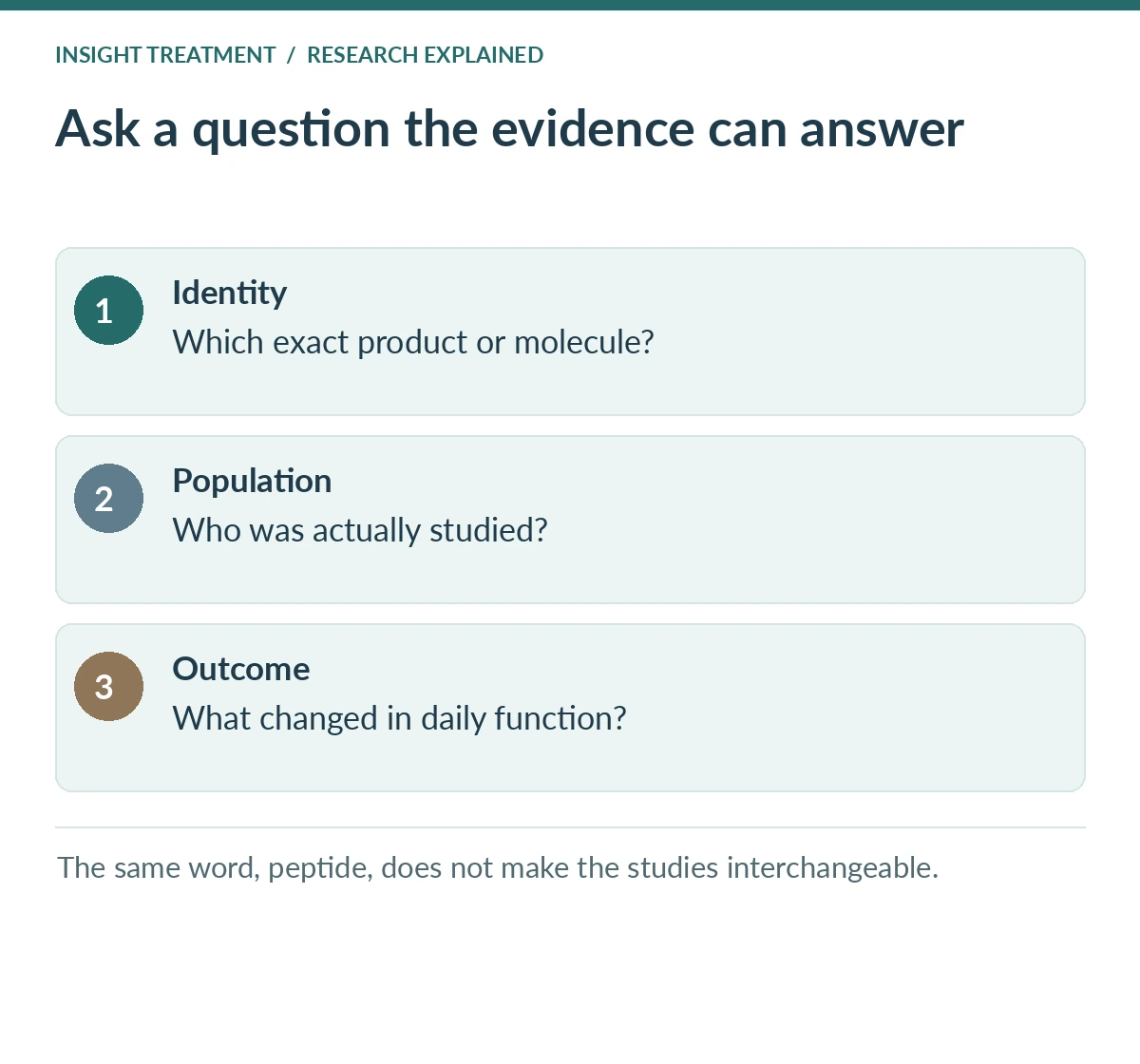
Cerebrolysin, Semax, Selank, DSIP, and MOTS-c appear together in online discussions, but their names describe different research subjects. A mixture is not interchangeable with one purified ingredient. A naturally occurring peptide measured in blood is not the same intervention as administering a manufactured product. A modified version of a molecule also needs its own identity and evidence.
The same distinction applies to products grouped under an energy label. NAD+ is a coenzyme, not a peptide; evidence about a precursor or an infusion cannot automatically establish a benefit for another preparation. Keep the exact name, formulation, route, and research population attached to every claim. The Cerebrolysin guide and MOTS-c overview explain two especially different examples.
| Question | Useful evidence to look for |
|---|---|
| Can this improve memory? | Human cognitive outcomes in a matching population, not a pathway alone. |
| Can this improve sleep? | Sleep timing, continuity, daytime function, and the actual intervention. |
| Can this improve energy? | Defined fatigue or functional outcomes rather than a metabolic marker alone. |
| Does this product match a study? | Exact identity, preparation, route, and supporting documentation. |
Separate an effect on a marker from a useful outcome
Researchers can measure a hormone, a brain-imaging signal, a blood marker, a questionnaire, or an everyday activity. All can contribute information, but they answer different questions. A marker may help explain a mechanism without proving that symptoms improve. A statistically significant change can also be too small, too temporary, or too indirect to settle the decision a reader faces.
In the CARS randomized trial, the principal question concerned upper-limb function after stroke, alongside rehabilitation. That is a specific clinical setting, not a general test of sharper thinking. By contrast, MOTS-c exercise research includes endogenous measurements in people and intervention experiments in mice. The difference between measuring a substance and administering it is central to interpreting those findings.
Use the comparison group to test the story
An improvement during treatment does not, by itself, establish an effect caused by that treatment. Symptoms fluctuate, people recover, and other parts of care can change at the same time. The relevant comparison is what happened to similar participants who did not receive the experimental intervention, ideally under a design that minimizes differences in expectations and follow-up.
Ask whether both groups received the same rehabilitation, sleep guidance, or usual care. Look for the outcome specified before the results were known. Also check whether everyone who started was included in the analysis. A graph showing only the people who completed a program can give a different impression from the experience of the full group. These questions are practical reading tools, not reasons to dismiss every early study.
Match the article to your next question
The main compound guides establish identity and research scope. Benefits pages examine particular outcomes. Side-effect pages separate observed events from missing information. Comparison articles are useful when two names are being presented as alternatives, even when their strongest evidence concerns entirely different conditions.
For sleep-related questions, start with DSIP and the sleep research before deciding whether a comparison with melatonin is meaningful. For concentration concerns, use the brain-fog comparison to distinguish symptoms from diagnoses and outcomes from mechanisms. A useful sequence often involves two or three focused pages, rather than reading every compound overview in the library.
Turn an online claim into a useful conversation
Bring the exact product description and the claim that interested you to the relevant clinician or pharmacist. Explain the problem you want to address, your current medicines, and what you understood the evidence to show. This makes the conversation more productive than asking whether peptides are good or bad as a group.
A concise note can contain four items: the daily activity affected, the proposed product, the study being cited, and the result you would consider worthwhile. It should also record what remains unknown. A lack of an established answer is different from a negative result, and both are different from a successful trial. Keeping those categories separate helps readers avoid turning uncertainty into either a promise or a blanket dismissal.
Common questions
Does a human study mean a compound works for every adult?
No. A human study can be relevant only to its participants, intervention, comparison, and outcomes. It may provide a starting point without answering a different condition or use.
Should every peptide have a dosage chart?
No. A chart is useful only when its figures have a clearly identified clinical or research context. A number separated from its product and population can be misleading.
Where should a new reader start?
Choose the guide matching the question: neurological outcomes, sleep, fatigue, or product identity. Then follow the relevant comparison or safety page rather than moving between unrelated claims.