
At a glance
Semax is a synthetic peptide discussed in neurological and cognitive research. Its clinical and laboratory literature should be read by population, outcome, and exact formulation rather than treated as proof of a general focus-enhancing effect. A study in stroke rehabilitation and an imaging study in healthy volunteers can each be informative while answering very different questions. Modified products marketed under related names also need separate identification before the evidence can be applied.
In this article
Identify Semax before interpreting a claim
A named peptide, a modified analogue, and a finished nasal product are different levels of description. A product page may move among them without making the change explicit. Record the exact molecule or variant, formulation, concentration, excipients, and route before comparing it with a paper.
This is especially important for labels that add terms such as acetylated or amidated. A chemical modification is not merely a branding choice. Evidence for one material does not automatically establish the effects, exposure, or tolerability of another. The practical question is whether the studied intervention and the offered product genuinely match.
What stroke research can contribute
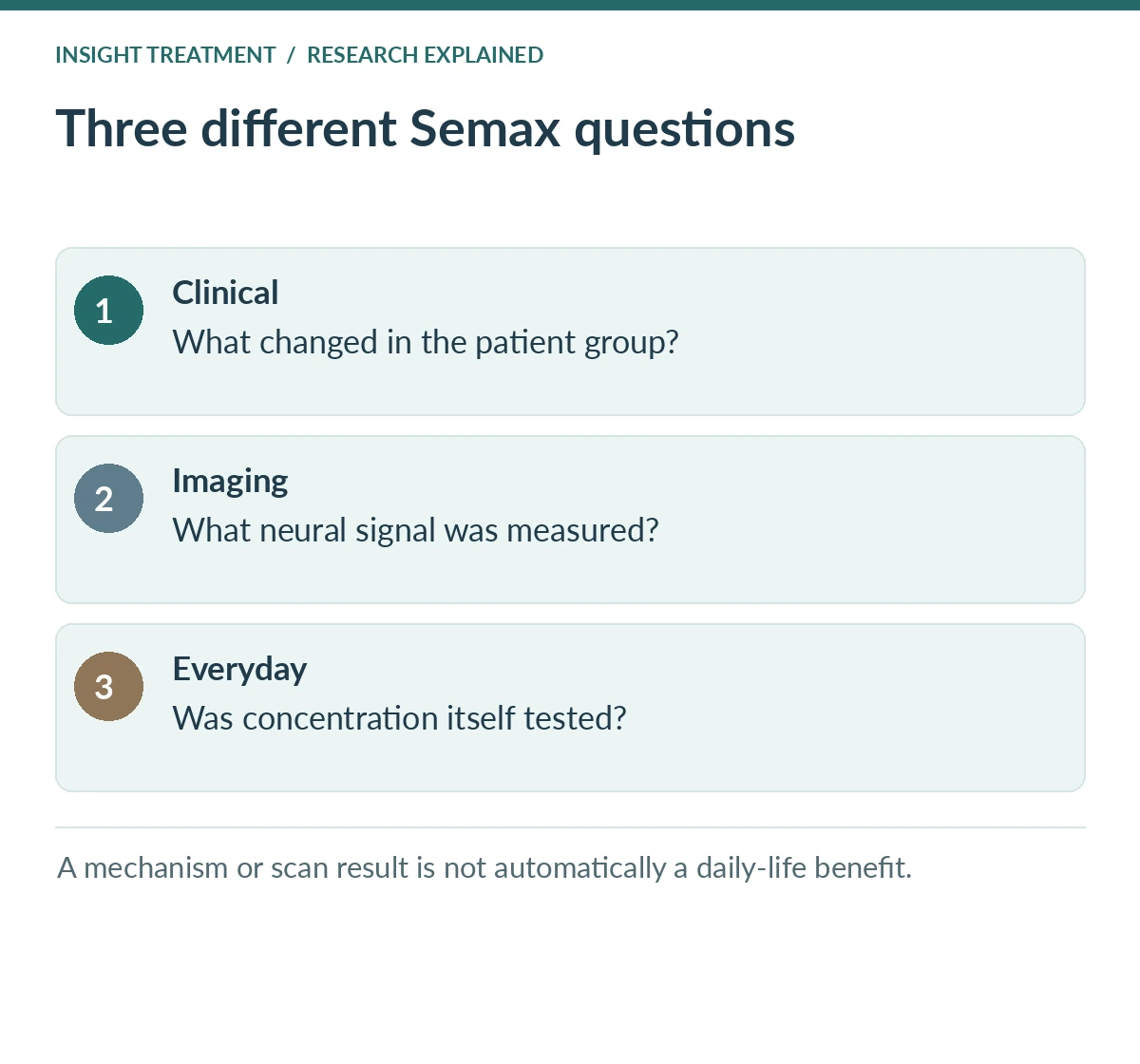
A Semax study during stroke rehabilitation examined functional measures and BDNF in a defined patient population. Its findings concern that neurological setting. They should not be rewritten as a controlled demonstration of better concentration in otherwise healthy adults.
A useful summary identifies the study design as well as the result. Look at how groups were formed, what rehabilitation they received, whether assessment was blinded, and how the comparison was analyzed. The presence of a measured biomarker can add biological context, but it does not remove the need to understand the clinical outcome and the limitations of the design.
| Evidence type | Question it can address | Question it does not settle alone |
|---|---|---|
| Stroke-rehabilitation study | Outcomes in the enrolled patient group | General healthy-adult cognitive enhancement. |
| Brain-imaging experiment | Changes in measured neural signals | Lasting improvements in daily concentration. |
| Product label | What the seller says the item contains | Clinical equivalence to every Semax study. |
| Personal experience | An individual's report | Causation or a reliable response rate. |
What a brain-imaging result means
The resting-state network study of Semax investigated changes in brain-imaging measures in healthy volunteers. Such work can suggest how a substance affects activity or connectivity under the experiment's conditions. It does not, by itself, show a durable improvement in memory, attention, work performance, or a diagnosed mental-health condition.
An imaging difference is therefore a starting point for a hypothesis, not a substitute for a functional benefit. Ask whether the researchers directly measured the everyday outcome being claimed and whether the study was large and long enough to assess it. A colorful scan can be compelling while still leaving the central practical question unanswered.
Why focus, mood, and recovery need separate evidence
Online descriptions often combine focus, mood, stress resilience, and neurological recovery. Those terms involve different experiences and clinical outcomes. A memory test does not establish an antidepressant effect; a recovery scale does not establish a productivity benefit; a mechanism does not establish either.
For a reader with brain fog, the focused Semax article examines the difference between a symptom description and a research population. For a comparison with another compound, see Semax versus Selank or Cerebrolysin versus Semax. Each comparison should retain the actual question rather than turn the products into interchangeable nootropic options.
Safety claims should be as specific as benefits claims
A small report with limited adverse-event detail cannot establish a complete risk profile. Route, product quality, other medicines, and health history can change the relevance of the available information. A phrase such as well tolerated should be read within the specific study rather than treated as a guarantee for every formulation.
The Semax side-effects guide examines how to distinguish observations, plausible concerns, and unknowns. It also explains why an absent database entry is not proof of a safe medication combination. The label nootropic describes a marketed purpose; it does not supply the safety data needed for a particular adult.
A useful way to read the next article or product page
Separate the page into three types of statement: what the product is, what researchers observed, and what the author predicts or recommends. Predictions should not be presented as observed results. Product specifications should not be presented as clinical outcomes. References should identify the actual intervention rather than merely mention a related biological pathway.
When a claim interests you, write down the promised outcome and follow the source to its measured endpoint. If the endpoint is different, the missing step should remain visible. That habit makes it easier to recognize useful emerging research without letting a promising mechanism become an unsupported promise about daily life.
Common questions
Are all Semax variants equivalent?
No equivalence should be assumed from the name alone. Sequence modifications, formulation, and route need to be matched to the evidence.
Does increased brain connectivity mean better thinking?
Not automatically. A measured imaging change needs a demonstrated relationship to a meaningful cognitive outcome.
Can stroke findings be applied to ordinary distraction?
Not without evidence addressing that different population and outcome.