
At a glance
A Cerebrolysin dose reported in a paper belongs to a particular product, patient group, route, and clinical protocol. Stroke and traumatic-brain-injury studies have used different regimens, and those differences should not be flattened into a universal wellness cycle. The numbers below describe published research settings. They explain what was tested, why milliliters need a defined formulation, and which details are lost when a study schedule is copied into a general dosing chart.
In this article
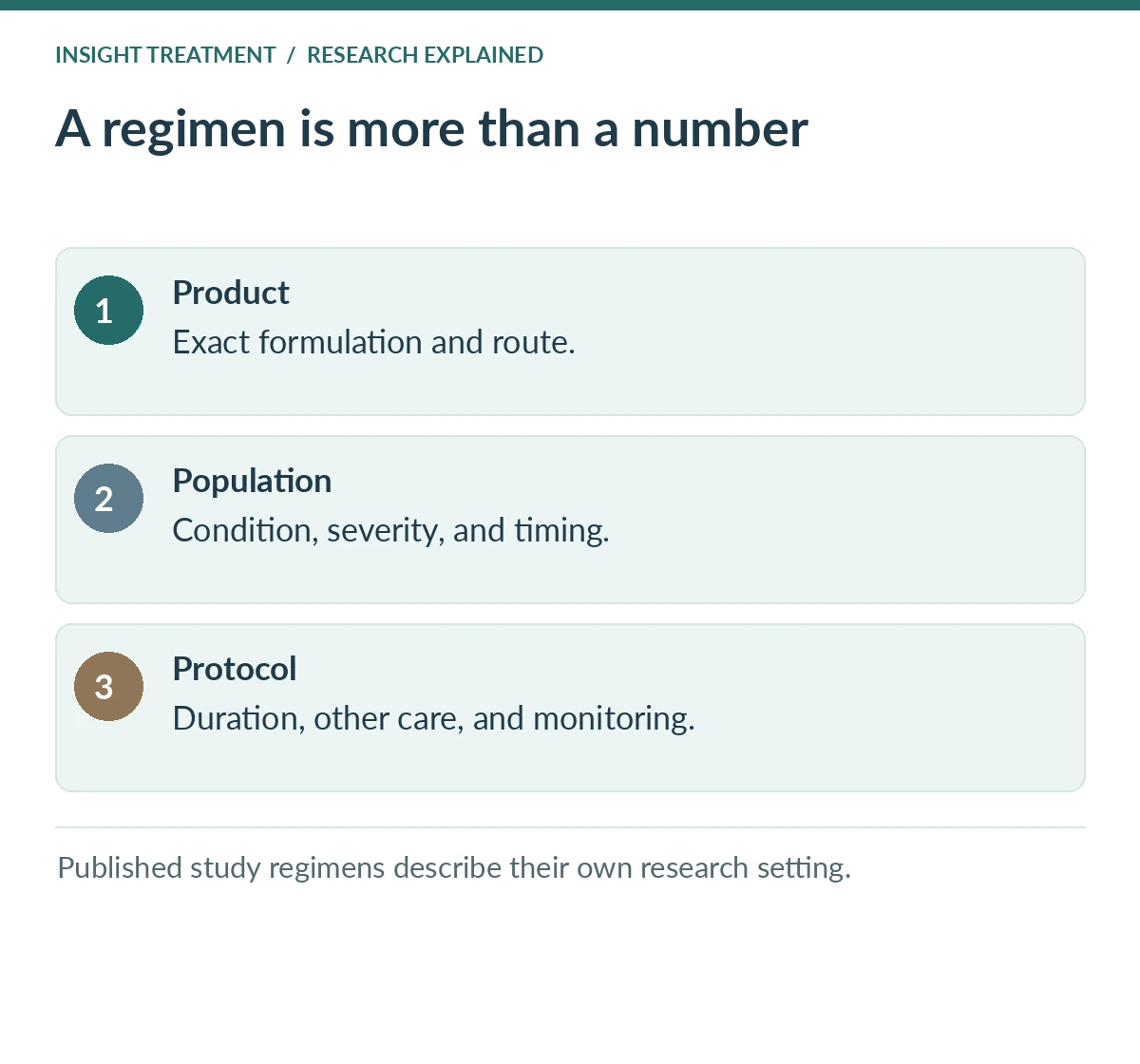
Read the regimen as a complete intervention
A regimen includes more than the amount administered. It also includes the preparation, route, timing relative to illness or injury, frequency, duration, co-interventions, and monitoring. Removing any of those details changes the question. A figure taken from acute hospital care cannot simply be reinterpreted as a protocol for longstanding concentration problems.
Start by writing the trial's patient group next to its dose. Then add the outcome it was designed to assess. This small step prevents a common error: selecting the largest or most frequently repeated number online without asking what problem it addressed. A research table should preserve the context rather than make it disappear.
Two examples with different clinical contexts
The CARS stroke-rehabilitation trial reported Cerebrolysin at 30 mL daily for 21 days, with standardized rehabilitation and a later arm-function endpoint. The CAPTAIN II brain-injury trial used an initial 50 mL daily period followed by two additional treatment cycles at 10 mL daily, each lasting 10 days, as an adjunct to standard care.
Those are descriptions of study methods, not competing versions of one general-purpose schedule. The populations, injury types, timing, and outcome strategy differed. Neither example establishes an effective regimen for a healthy adult seeking more energy, nor does comparing the daily amounts identify which intervention is better. The stroke and brain-injury articles explain the corresponding outcomes.
| Study context | Published regimen | Interpretation |
|---|---|---|
| Stroke rehabilitation, CARS | 30 mL daily for 21 days | Paired with standardized rehabilitation; a later motor endpoint. |
| Moderate-to-severe TBI, CAPTAIN II | 50 mL daily for 10 days, then two 10-day cycles at 10 mL daily | A staged clinical protocol added to standard care. |
| General wellness or concentration | No universal regimen established by these studies | The patient group and question do not match either protocol. |
Milliliters identify volume, not one purified molecule
A volume is meaningful only when the preparation is identified. Cerebrolysin is a mixture, so its concentrate amount is not the mass of one isolated peptide sequence. A syringe marking also describes volume, not a universal unit of neurological effect. Converting a trial's volume into a generic peptide dose can therefore create an appearance of precision without preserving the substance studied.
The formulations guide explains the label fields to match: product name, manufacturer, concentration, container volume, and dosage form. A differently formulated product cannot be assumed equivalent just because a seller uses the same brand name in a description. Likewise, a nasal or oral offer requires evidence for that actual route and preparation.
Why routes and treatment settings cannot be swapped
Hospital protocols specify how an intervention is delivered and monitored. They do not establish that another route will produce the same exposure or that a home-prepared product has comparable quality. The route, finished formulation, and clinical observation are parts of the intervention, not incidental packaging details.
A paper may provide enough information to reproduce a research procedure within an appropriately supervised study. That is different from supplying a safe implementation plan for an individual reader. Reconstitution recipes, mixing instructions, or syringe conversions do not close the evidence gap. They can instead distract from the more important question of whether the intended use has an applicable regimen at all.
More treatment is not automatically more benefit
Dose-response relationships have to be measured. A larger amount may change exposure, adverse effects, or treatment burden without producing a larger useful outcome. Different studies cannot establish a dose-response relationship if the patients, endpoints, or methods also differ.
Similarly, a short-term result does not define how frequently a course should be repeated or how long an improvement will persist. Those questions need follow-up and appropriately designed comparisons. A seller's cycle can look organized while resting on no study that tested that actual cycle. Ask which source supports the schedule as a whole, not whether each number can be found somewhere in the literature.
What a useful clinical review should clarify
Bring the full study or product description rather than a cropped dose chart. The important questions include the clinical indication, the exact preparation, contraindications, concomitant medicines, monitoring, and how an outcome would be evaluated. A clinician may conclude that the evidence does not apply to the proposed use; that is a substantive answer to a dosage question.
A good discussion should also distinguish an evidence gap from a disagreement about preference. If the product, population, or route is different, there may be no validated conversion to negotiate. Read the safety article alongside this methods guide, especially when the product is being considered with other medicines or outside the setting described in its documentation.
Common questions
Can I convert these study amounts into a wellness cycle?
The studies do not validate that conversion. Population, product, route, monitoring, and purpose would all need to match an applicable clinical assessment.
Is a higher daily volume more effective?
Not necessarily. Dose-response and comparative benefit require a study designed to answer that question.
Does one course establish when another should begin?
No. Repeated-course timing and long-term outcomes need their own evidence; they cannot be derived from a short treatment window alone.