
At a glance
Cerebrolysin safety depends on the exact product, clinical situation, and accompanying medicines. Product contraindications and adverse-event findings are different kinds of information, and neither should be replaced by a blanket claim that a preparation is safe. The available studies do not establish a reliable side-effect rate for healthy adults using it for brain fog or wellness. The practical task is to identify the relevant warnings, the population studied, and the limits of the safety reporting.
In this article
Separate adverse events from adverse reactions
An adverse event is something unfavorable that happens during a study. An adverse reaction is an event judged to be caused by the product. That distinction matters in stroke and brain-injury populations, where illness itself can produce complications. A long list of events is not automatically a list of drug effects, and a short list is not automatically evidence of safety.
Look for how events were collected: scheduled questioning, laboratory monitoring, hospital records, spontaneous reports, or some combination. Check the duration and the number of exposed participants. Without those details, a percentage may look precise while giving very little information about an adult considering a different use or product.
Start with the product-specific contraindications
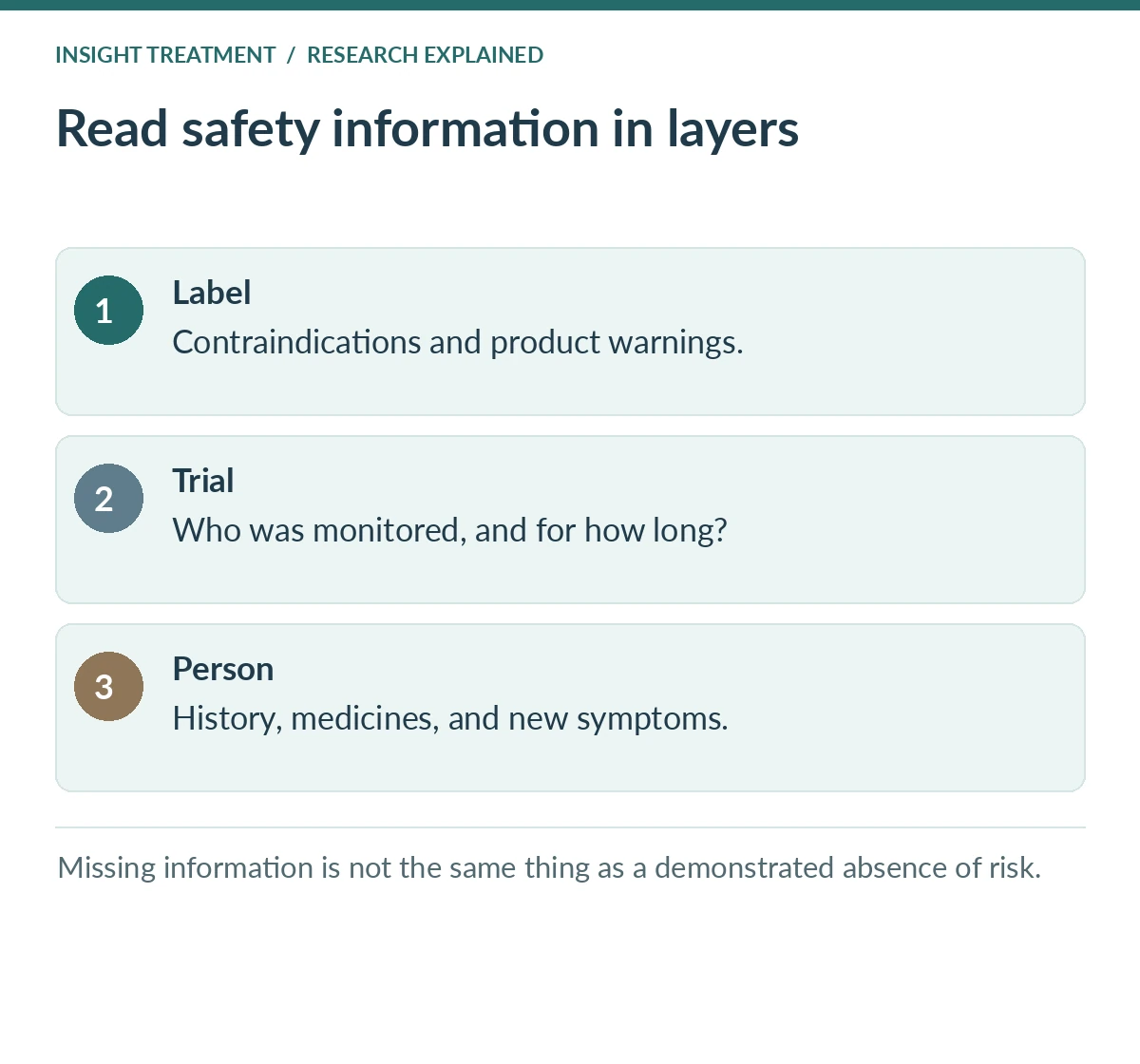
The manufacturer's prescribing-information summary lists hypersensitivity to components, epilepsy, and severe renal impairment as contraindications. These are not interchangeable with mild, transient symptoms reported during a trial. They identify circumstances where the product information says the preparation should not be used.
A safety conversation therefore needs the actual medical history and medication list, not just a label reading natural or peptide-based. A clinician or pharmacist should see the full product description, particularly when an online item uses a similar name or different route. The formulations article explains why a branded solution, an unidentified mixture, and a differently formulated product should not share one assumed safety profile.
| Safety question | Information needed |
|---|---|
| Is the product contraindicated? | Exact preparation plus seizure, kidney, allergy, and other relevant history. |
| Was an event caused by treatment? | Timing, comparator data, clinical assessment, and other possible causes. |
| Can a trial rate be applied here? | Matching population, route, duration, product, and monitoring. |
| Can it be combined with medicines? | A complete medication and supplement review, not a general compatibility claim. |
What a large stroke trial can tell us
The CASTA randomized trial provides adverse-event observations in an acute-stroke population under a controlled protocol. Such data matter, but they describe the people, follow-up, and treatment conditions actually studied. They cannot establish a dependable risk percentage for a healthy person using an online product outside that setting.
Also distinguish whether a study could detect common short-term events from whether it could exclude uncommon or delayed harm. No realistic small or moderate-sized study can prove that every rare event is absent. When a trial report describes treatment as tolerated, read it as a statement about that observed experience rather than an unlimited safety certificate.
Why product changes alter the question
An online product may differ in manufacturer, concentration, route, storage history, excipients, or labeling. Those differences can change what evidence is relevant. A certificate reporting a chemical measurement does not by itself demonstrate sterility, appropriate manufacturing, or safety for the intended route. The test has to answer the question being asked.
Packaging photographs are useful for identifying an item but cannot prove that its contents or handling match the image. The same applies to testimonials: a seller cannot establish a general adverse-event rate from selected favorable accounts. Compare product documentation and clinical evidence as separate tasks rather than letting one stand in for the other.
Medication combinations need a specific review
A phrase such as compatible with antidepressants is incomplete without the exact antidepressant, other medicines, product, route, and relevant history. A lack of a listed interaction in one database may mean that the combination has not been studied. It is not the same as a trial demonstrating that the combination is safe.
The peptides and antidepressants guide provides a structured way to prepare the medication review. Do not stop or reduce an established medicine to make room for an experimental product based on a seller's suggestion. The change itself can produce symptoms that are then mistaken for a peptide benefit or adverse effect.
Make a safety report useful
If a new symptom appears during treatment, record the exact product, amount administered, route, timing, batch information, other medicines, and what changed. Bring that record to the treating professional rather than using an online comparison as a reason to repeat the exposure. Severe symptoms such as breathing difficulty or a seizure require urgent medical assessment.
For ordinary follow-up, describe the event concretely: dizziness while standing, trouble sleeping, nausea, an injection-site change, or worsening function. A symptom description is more useful than deciding in advance that the product caused it. The main Cerebrolysin guide and research-regimen article help identify which preparation and clinical setting are actually being compared.
Common questions
Does being a peptide mean fewer side effects?
Chemical category alone does not determine safety. The preparation, exposure, medical history, and evidence matter.
Is an absence of reported events reassuring?
It may describe what happened in a study, but the strength of that reassurance depends on how many people were followed, for how long, and how events were sought.
Can an online seller verify medical suitability?
Product documentation and a medical suitability assessment are different tasks. A seller statement cannot replace a review of the actual preparation and individual history.