
At a glance
Cerebrolysin is a prescription neuropeptide preparation made from porcine brain proteins, not a single synthetic peptide with one sequence. It has been studied in defined neurological populations, including people recovering from stroke or traumatic brain injury and people with cognitive impairment. Those studies are different from demonstrating a general benefit for healthy adults with stress, distraction, or fatigue. Understanding the exact product and the question a trial asked is the best starting point for evaluating the claims.
In this article
A mixture, rather than one isolated peptide
The manufacturer describes Cerebrolysin as a solution for injection containing a defined concentrate. Its product information gives the composition, excipients, contraindications, and market-specific prescribing context. The preparation is derived from porcine material. That identity matters when comparing a branded ampoule with a generic online listing, a differently named mixture, or an ingredient claimed to be equivalent.
A familiar brand name is not enough to establish equivalence. Look for the manufacturer, exact product name, dosage form, concentration, package contents, and local product record. An image of an ampoule or a downloadable certificate can help identify a claim, but neither independently proves that the supplied item matches the medicine used in a study. The formulation guide examines that distinction in more detail.
What the neurological studies are trying to change
Neurological studies may assess arm movement, independent living, memory tests, disability scales, or a combination of functions. These outcomes should be read individually. Improvement on one measure does not automatically mean a participant returned to work, no longer needed care, or experienced a lasting change in every symptom.
The CAPTAIN II trial investigated Cerebrolysin alongside standard care after moderate-to-severe traumatic brain injury, using multiple outcome scales. That provides information about a particular injury setting. It does not establish an effect on ordinary distractedness or performance enhancement in someone without a brain injury. The distinction is about the question studied, not about whether one person's difficulty matters more than another's.
| Item to identify | Why it changes the interpretation |
|---|---|
| Preparation | A mixture is not interchangeable with one isolated peptide. |
| Population | Stroke, traumatic injury, and memory complaints are different research questions. |
| Outcome | A test score, daily function, and subjective wellbeing are not the same endpoint. |
| Setting | An adjunct to standard care is not evidence for unsupervised use. |
Why the surrounding care matters
When an intervention is added to rehabilitation or standard neurological care, both parts belong in the interpretation. A reported improvement cannot be described as the effect of a stand-alone product when participants also received intensive support. The appropriate question is whether the experimental addition improved outcomes compared with otherwise similar care.
This also helps explain why personal accounts can be difficult to compare. Timing after injury, baseline severity, rehabilitation intensity, other medicines, sleep, and follow-up can all differ. A meaningful comparison needs more than two people saying that they felt better. For the condition-specific discussion, see Cerebrolysin and stroke recovery or the traumatic brain injury evidence.
Benefits claims need their own outcome
The word neuroprotection describes a research idea; it does not specify the improvement a patient can expect. A claim about memory needs cognitive testing in the relevant population. A claim about independence needs a functional measure. A claim about mood needs an appropriate mental-health outcome. Moving between those claims without showing the corresponding data is a common source of confusion.
When reading a benefits summary, ask for the actual outcome and comparator. Then ask whether the effect was measured during treatment or after a follow-up period, how many people were assessed, and how incomplete results were handled. The benefits article organizes those questions without treating all neurological findings as one universal result.
What safety information can and cannot establish
A medicine may have product information and clinical experience while still leaving important questions unanswered for a different population or combination. Tolerability in a selected trial is not a guarantee of safety for every reader. The product's own contraindications and the person's medical history matter alongside the trial results.
This is particularly important when a product is marketed for unsupervised optimization rather than the clinical context in its evidence. The side-effects guide distinguishes adverse-event reporting, contraindications, formulation concerns, and limits on estimating individual risk. A source that reports no difference in a small study has not demonstrated the absence of uncommon or long-term problems.
A practical way to evaluate an offer or recommendation
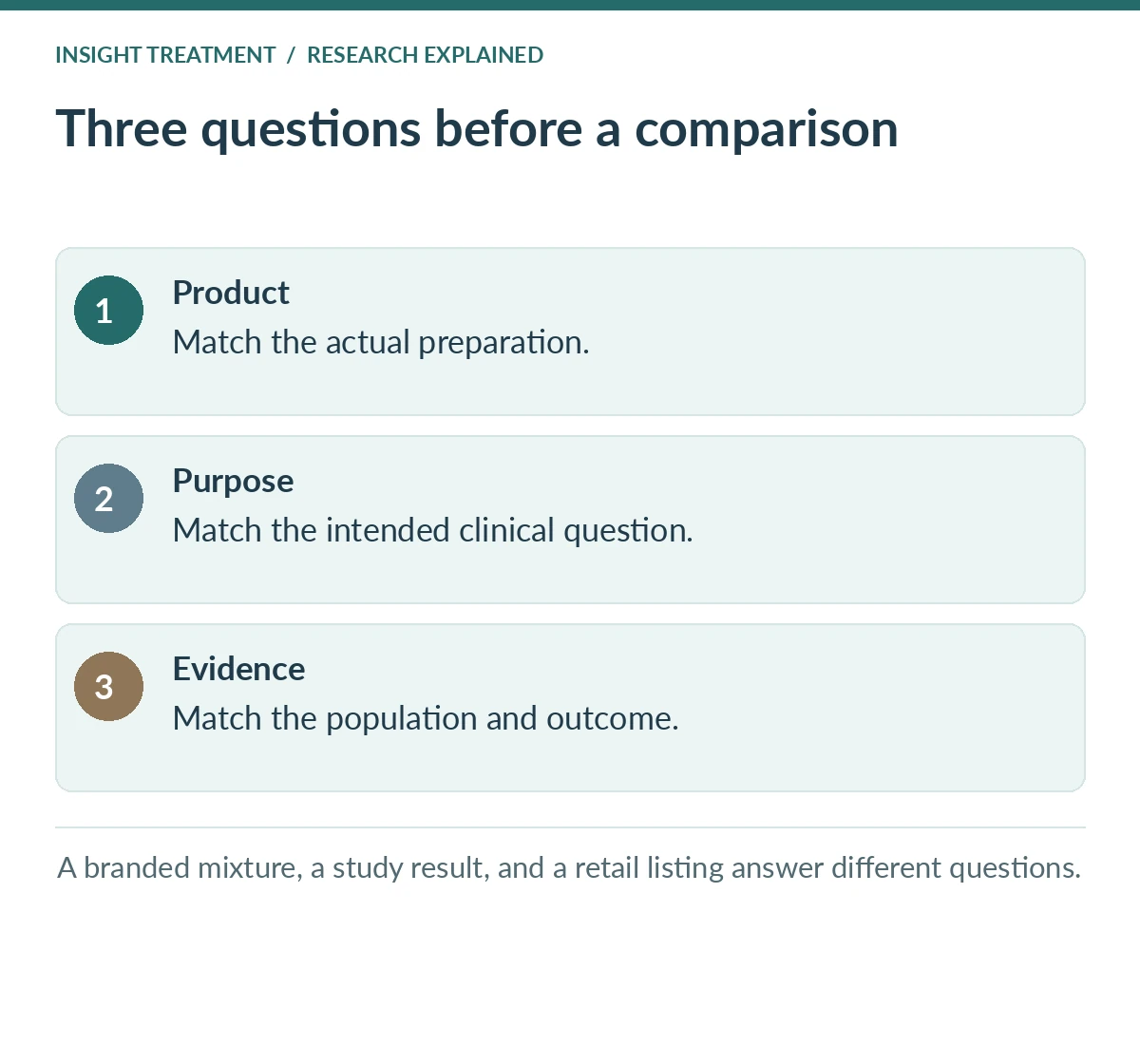
Keep three questions separate. First, is the item the product it claims to be? Second, is there relevant evidence for the intended use? Third, is the offer appropriate and available through a legitimate route in the buyer's jurisdiction? A positive answer to one does not settle the other two.
The manufacturer notes that its prescribing information varies by country and that the medicine is not FDA-approved for sale or distribution in the United States. An online listing does not resolve that difference. Before comparing prices, identify the actual preparation and access route. That prevents a low price, familiar packaging, or persuasive testimonial from becoming a substitute for the information needed to make sense of the offer.
Common questions
Is Cerebrolysin a single peptide?
No. It is a defined mixture containing peptides and other components. Research on one component does not establish equivalence to the complete preparation.
Do injection studies support nasal products using the same name?
Not automatically. Route, composition, and product identity must match, or the different product needs its own supporting evidence.
Does neurological research prove a benefit for brain fog?
No. Brain fog is a symptom description, while the major neurological studies involve specified conditions and outcomes. Relevance has to be demonstrated rather than assumed.