
At a glance
The most useful way to examine Cerebrolysin benefits is outcome by outcome. Research has considered movement after stroke, multidimensional recovery after traumatic brain injury, and cognition in selected patient groups. A favorable finding in one setting is not proof of broad brain enhancement or a prediction for an individual. This guide focuses on how to tell what improved, what it was compared with, and whether that improvement matches the result an adult or family is seeking.
In this article
Define the benefit before judging the result
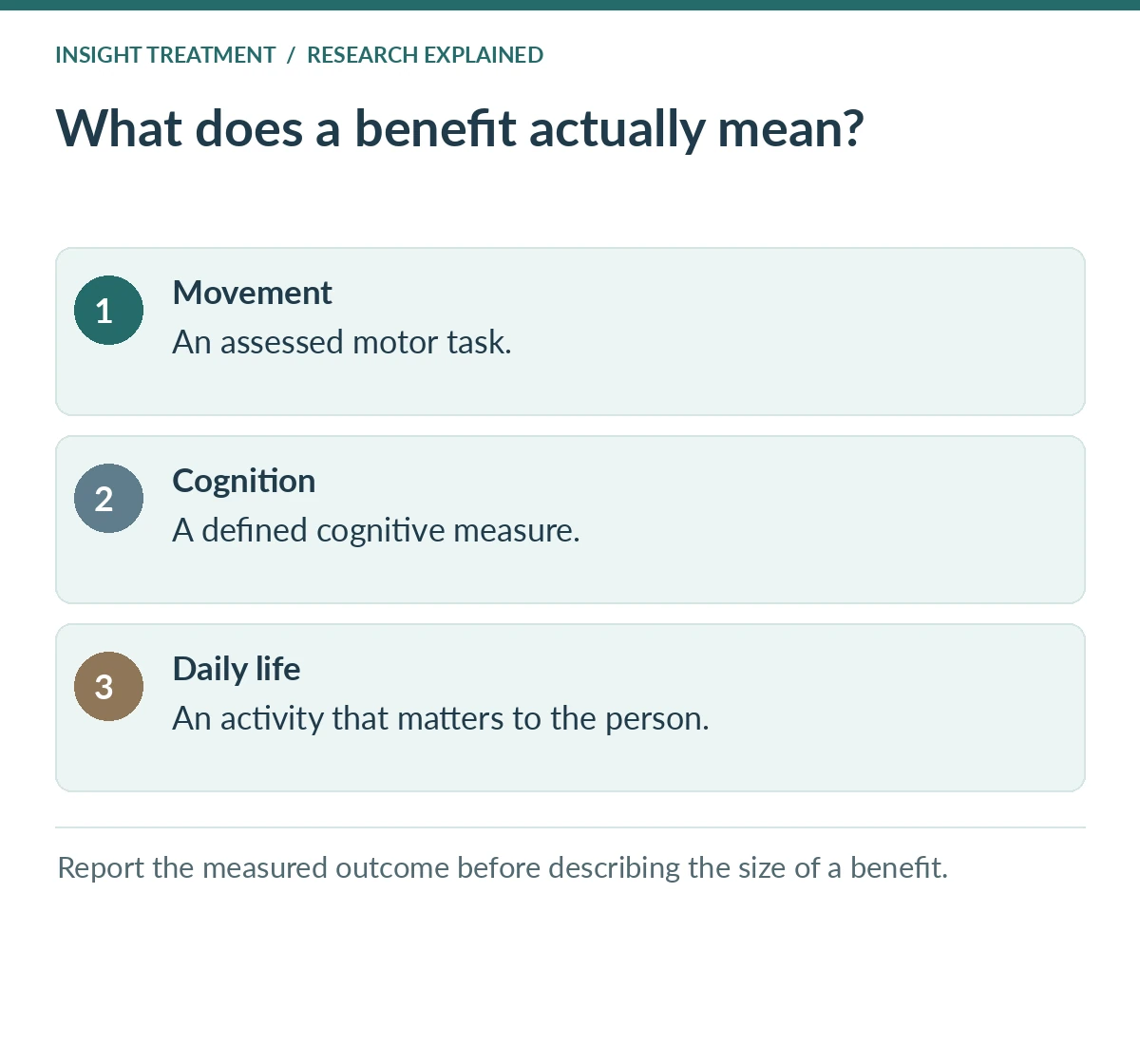
A benefit claim needs a clear object. Better arm function is not the same as better memory; a lower symptom score is not the same as living independently. When a summary simply says that brain function improved, the reader cannot tell which of these outcomes was assessed. Begin with the measure, then ask what its change would mean outside the clinic.
This approach also makes apparently conflicting summaries easier to understand. Two trials can differ because one targets an impairment and another targets disability or overall recovery. A narrow favorable result can be worth studying further without settling every broader claim. The question is how much the result supports, not whether it can be made to sound positive.
Movement and rehabilitation outcomes
In the CARS trial, Cerebrolysin plus a standardized rehabilitation program was associated with better performance on the primary arm-function assessment than placebo plus rehabilitation. The measure was the Action Research Arm Test. Its tasks involve using the affected arm and hand; it is not a memory test or a general wellness score.
For interpretation, keep the rehabilitation program attached to the result. Ask whether the outcome matters for the activity the patient hopes to regain and whether the starting impairment resembles the study population. A difference on a structured test can be clinically relevant, but the paper still needs to show how that relates to everyday independence. The stroke guide examines the wider trial picture rather than relying on this result alone.
| Claim | What would support it |
|---|---|
| Better arm function | A measured motor outcome in the relevant stroke-rehabilitation population. |
| Improved injury recovery | A clinically interpretable difference compared with otherwise similar care. |
| Better memory | Cognitive outcomes in a matching population and condition. |
| Lasting benefit | Follow-up showing what remained after the treatment period. |
Recovery after traumatic brain injury
The CAPTAIN II study reported a favorable result on a combined set of outcomes after moderate-to-severe traumatic brain injury. It examined treatment as an addition to standard care. A composite can capture several aspects of recovery, but it should not be rewritten as a promise that every component improves by the same amount.
A reader should check which outcomes contributed, how injury severity was defined, and what rehabilitation or other treatment both groups received. A person with a mild concussion, longstanding fatigue, or isolated memory worries may differ substantially from the participants. The brain-injury article explains why those boundaries are especially important for family-facing summaries.
Memory, concentration, and the healthy-reader problem
Memory questions need their own evidence. A neurological study can be rigorous and still fail to answer whether a healthy adult will remember names more easily or concentrate longer at work. The conclusion cannot be transferred just because both outcomes involve the brain.
When a product page connects a patient study with an optimization claim, identify the missing step. Was the new population tested? Was the intended symptom measured? Was there a comparison group? Did the follow-up show that the change persisted? The memory and concentration guide takes up those questions separately, so a general benefits summary does not become a substitute for population-specific evidence.
Absolute changes are more informative than impressive wording
A claim of significant improvement should prompt a request for the actual scale, baseline, and between-group difference. Statistical significance alone does not say how noticeable the change would be in daily life. A percentage can also be difficult to interpret when it describes a relative change on a scale rather than the proportion of people who regained a specific ability.
If a report uses a composite or standardized effect size, ask what real-world task it helps explain. Was the participant able to perform an activity, did the score move modestly, or was the outcome a laboratory measurement? None of those should be substituted for another. A useful benefits table makes the unit of improvement explicit rather than choosing the most dramatic-sounding number.
Balance potential benefit against uncertainty and burden
The time, monitoring, access requirements, expense, and potential adverse effects are part of a treatment question. Even a plausible benefit may be too uncertain, too small, or too poorly matched to a person's situation to justify an offer. That assessment cannot be made from a benefits list alone.
Use the side-effects page alongside the positive findings, and compare the results and follow-up discussion with the outcome you actually want. A balanced reading is not a contest between enthusiasm and skepticism. It is an attempt to connect the strongest available evidence to a defined problem, while keeping the remaining uncertainty visible.
Common questions
Are all reported benefits equally well supported?
No. The evidence differs by condition, outcome, study design, and preparation. A result in one area cannot be used to fill gaps in another.
Does a higher score mean recovery is complete?
No. A scale measures a defined aspect of function. Improvement can be meaningful without representing full recovery or independence.
Can trial averages predict an individual result?
They describe groups under study conditions. They do not establish the amount, timing, or certainty of improvement for a particular person.