
At a glance
Cerebrolysin before-and-after claims are most informative when they describe a defined ability measured before treatment and at a planned follow-up. Photos, vague reports of feeling sharper, and percentages without a scale cannot show the same thing as a controlled clinical assessment. Research timelines also separate treatment days from later outcome visits. This guide explains how to read those timelines without turning a group result into a promise about how quickly an individual will feel different.
In this article
- What a meaningful before-and-after comparison contains
- Treatment duration and outcome timing are different
- Longer cognitive studies answer another question
- Why personal stories cannot supply a reliable timetable
- Use a record of function rather than chasing a dramatic feeling
- Read result claims alongside safety and product identity
What a meaningful before-and-after comparison contains
A useful comparison begins with the starting problem, a measurement that captures it, and a planned time to repeat the measurement. Examples include a task involving the affected hand, a structured memory test, or the level of assistance needed for an activity. The same assessment should be used consistently, and changes in rehabilitation or other care should be recorded.
An image of a person looking healthier cannot establish a neurological treatment effect. Nor does a statement that cognition improved by a percentage tell you what was tested. Ask for the unit, baseline, and comparison group. A meaningful story should make it possible to distinguish improvement on a test from an improvement the person actually notices in everyday life.
Treatment duration and outcome timing are different
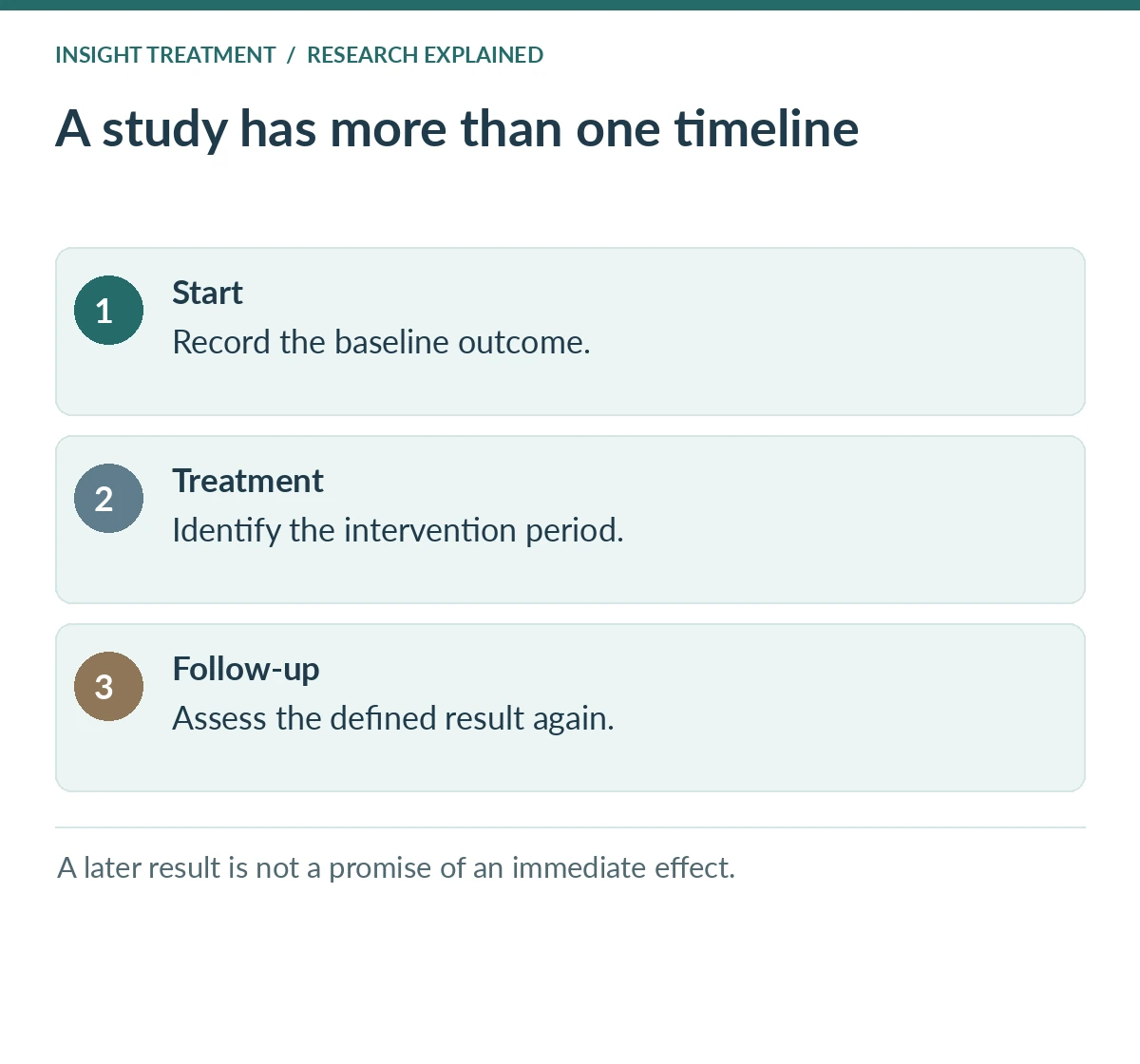
The CARS study used a treatment period followed by a later principal assessment of arm function. The assessment was not simply a report of how participants felt immediately after an administration. A clinical paper can therefore support information about a measured follow-up without establishing the moment when benefit first began.
When a headline compresses the whole study into works in a few days, compare that statement with the actual measurement schedule. The intervention window, first assessment, main endpoint, and later follow-up should be listed separately. A result at one visit does not reveal what happened on every earlier day.
| Timeline component | What it tells you |
|---|---|
| Baseline | The starting impairment or test performance. |
| Treatment window | When the study intervention was administered. |
| Outcome visit | When the specified ability was assessed. |
| Later follow-up | Whether the assessed change persisted in those followed. |
Longer cognitive studies answer another question
A placebo-controlled Alzheimer disease study followed cognitive and clinical outcomes over a longer period. Its participants and assessments differ from the stroke-rehabilitation setting. Combining these timelines into one universal Cerebrolysin results chart would imply that unlike conditions follow the same course.
For a family reading about memory, the meaningful question is which change was observed in the relevant patient group, and whether it persisted at the scheduled follow-up. For an otherwise healthy adult with concentration complaints, that study cannot provide a personal onset estimate. The memory article explains the difference between a diagnostic population and a broad symptom description.
Why personal stories cannot supply a reliable timetable
Personal reports often omit what else changed. Sleep, stress, daily routine, expectations, rehabilitation, other medicines, or the natural course of an illness can all affect how a before-and-after story reads. People with little improvement may also be less likely to post an update, while particularly striking accounts are shared repeatedly.
That does not make every account dishonest or useless. A careful account can identify questions worth investigating, practical burdens, or outcomes the formal study did not emphasize. It simply does not supply a response probability or causal proof. Treat a testimonial as a description of one person's experience, then look separately for evidence supporting the general claim.
Use a record of function rather than chasing a dramatic feeling
For a clinical discussion, choose a small set of relevant activities and describe them consistently. Record the assistance needed, the errors made, or the amount of an activity completed, rather than assigning a new global brain score each day. Keep the conditions similar enough that a comparison is interpretable.
A record might distinguish remembering an appointment without a prompt from remembering it after a reminder. It might distinguish walking with supervision from walking independently. These are examples of measurement, not a self-treatment experiment. The point is to make the desired outcome understandable to the care team, not to interpret daily fluctuations as proof that a product is working.
Read result claims alongside safety and product identity
A before-and-after page should identify the exact product and route, the population, the comparison, and any harms or discontinuations. Showing only the favorable outcome leaves out part of the experience. Follow-up losses also matter: the people available for the final assessment may not represent everyone who started.
Use the benefits review to locate the actual endpoint and the safety guide to examine what else was recorded. If a commercial offer uses a trial photograph, chart, or percentage, the supporting source should match the offered preparation and intended use. A clinical result is not a substitute for product verification.
Common questions
How quickly does Cerebrolysin work?
There is no single demonstrated onset time covering all uses. A trial assessment at a particular interval does not establish when an individual will first notice a change.
Are before-and-after photographs useful?
They can document visible facts, but they cannot measure memory, attention, independence, or causation. Those questions need suitable assessments.
Is feeling more alert evidence of neurological recovery?
Alertness is a particular experience. It should not be substituted for a measured change in memory, motor function, or disability.