
At a glance
Selank is a synthetic peptide discussed in anxiety-related and neurobiological research. A small human clinical comparison and imaging experiments provide specific observations, but they do not establish that every Selank product is a proven option for anxiety, stress, or concentration. The useful task is to identify what was tested, how symptoms were measured, and what the study design leaves unresolved. Selank should also be distinguished from Semax rather than treated as a calmer version of the same substance.
In this article
Start with the exact compound and product
A product description should identify Selank, the actual formulation, concentration, excipients, and route. Related names and modified versions should not be silently treated as the same intervention. A sequence or a label can help identify a claim, but clinical relevance still depends on matching the preparation used in the research.
The word anxiolytic in a description is not a substitute for a comparison of outcomes and harms. Nor does a product being marketed for stress mean it has been evaluated for the particular kind of distress an adult is experiencing. Define both the substance and the question before using a study to support a buying or treatment decision.
What the clinical comparison reported
A study involving 62 patients with generalized anxiety disorder or neurasthenia compared Selank with medazepam and reported changes on symptom scales. This is a concrete human research finding, but its size, comparator, methods, and clinical population limit the conclusion that can be drawn.
It should not be presented as equivalent evidence to a large program of independently replicated placebo-controlled trials. Nor does a comparison with a medicine establish that Selank can safely replace that medicine for an individual. The useful reading is to identify the precise outcome and design, then ask what additional evidence would be needed for the broader claim.
| Question | Useful distinction |
|---|---|
| What was tested? | Exact Selank preparation rather than a loosely related variant. |
| Who was studied? | A diagnosed clinical population or healthy volunteers. |
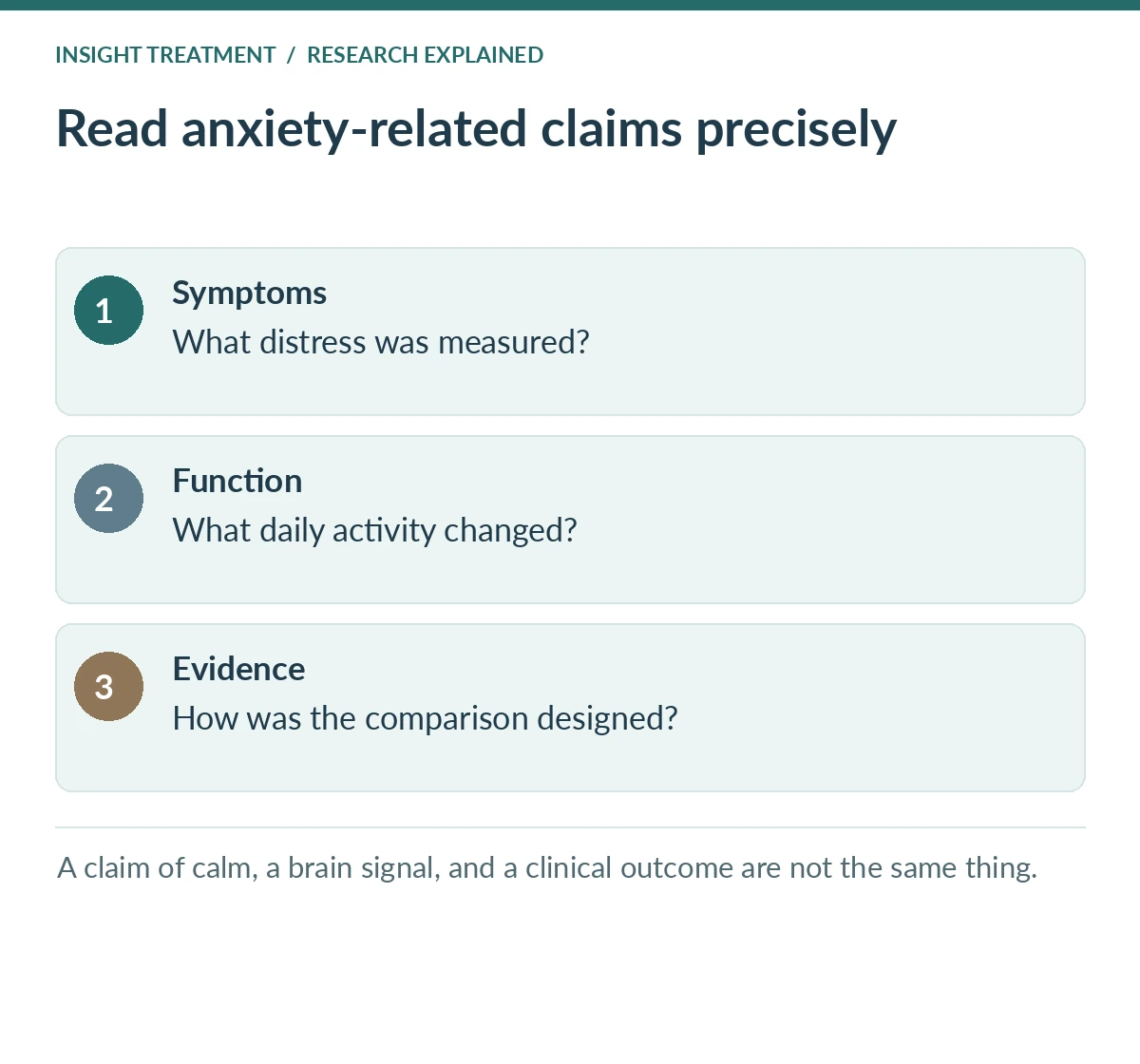
| What changed? | Symptoms, daily function, or an imaging measure. |
| How certain is the conclusion? | Design, size, follow-up, and independent confirmation. |
How imaging research differs from symptom research
The functional-connectivity study of Selank and Semax examined brain-network measurements in healthy volunteers. It offers a different kind of information from a clinical trial measuring anxiety symptoms and daily function. A change in connectivity is not automatically a change that a person experiences as helpful.
That distinction matters when imaging and clinical findings are placed together in a persuasive summary. They can contribute to a research hypothesis without becoming two independent demonstrations of the same benefit. The outcome needs to remain visible: network measurement, symptom score, daily activity, or another defined endpoint.
Stress relief, anxiety treatment, and sedation are different claims
Feeling less tense, having fewer panic symptoms, and feeling sedated are not interchangeable. A study should specify which was assessed, in what population, and with what consequences for daily life. A label that promises calm focus combines at least two outcomes that should be evaluated separately.
This is also why comparison with Semax needs care. The Semax versus Selank guide examines the differing research questions rather than assigning one compound to productivity and the other to relaxation. Those marketing categories can sound intuitive while extending beyond the evidence actually available.
Safety needs a complete medication picture
Many adults interested in anxiety-related products already use medicines or supplements. The full list matters, including intermittent sedatives, stimulants, sleep aids, alcohol, and recent changes. Missing interaction data should not be interpreted as evidence that combinations are harmless.
A medication review is particularly important before replacing or adding to an established psychiatric treatment. Stopping a medicine can produce symptoms that complicate interpretation of a new product. The interaction article explains how to prepare a concise record for a clinician or pharmacist without inventing a washout schedule or assuming that every peptide behaves alike.
What a responsible comparison should leave you with
A useful Selank page should state the exact intervention, describe the human findings without exaggeration, and distinguish clinical from imaging or laboratory evidence. It should also say which questions remain unresolved: comparative effectiveness, durability, broader populations, product equivalence, and safety with other exposures.
The next question should follow the reader's concern. Someone comparing names may need an identity table; someone worried about an established treatment needs a medication discussion; someone describing persistent anxiety needs assessment of that actual problem. Research interest can be valuable without turning a limited evidence base into a universal recommendation.
Common questions
Is Selank the same as Semax?
No. They are different research subjects. Similar branding or a shared discussion category does not make them interchangeable.
Does a small clinical study settle effectiveness?
It can contribute evidence, but broader claims require attention to design, replication, populations, and meaningful outcomes.
Can it replace prescribed anxiety treatment?
The studies described here do not establish an individual replacement plan. Changes to established treatment need a clinical review.